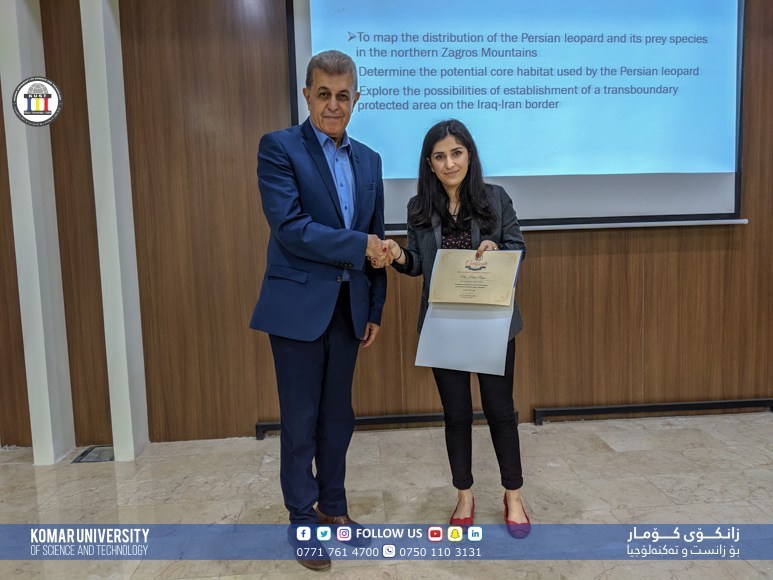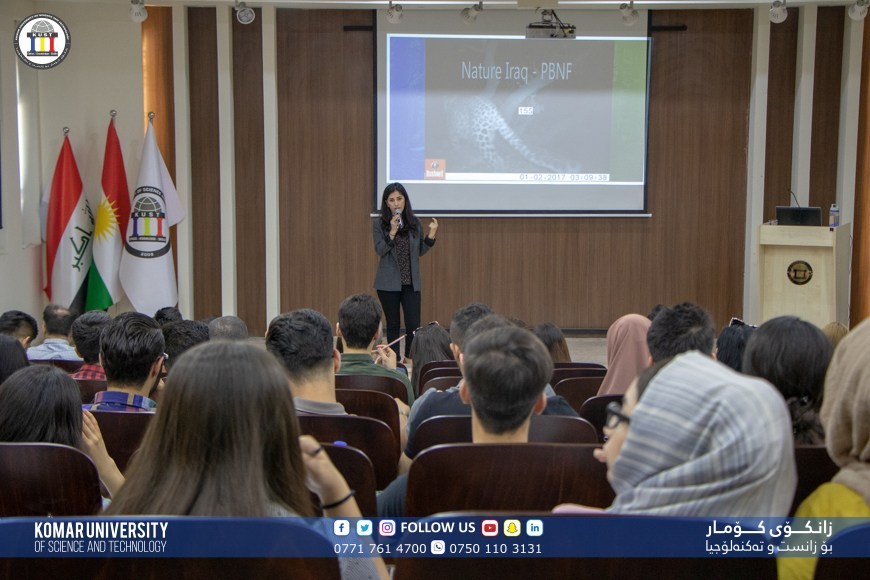
Ms Hana Raza from Nature Iraq Organization presented a seminar entitled “Distribution and Habitat Use of the Persian Leopard and Its Prey in the Northern Zagros Mountains” at KUST on Wednesday, June 26th. She began her speech with an introduction to the ecosystems around the world and how they are divided by political boundaries and often exposed to many wars and unrest due to complicated relations and various socio-cultural circumstances between countries. She added that these borders cross wildlife habitats, halting the movement of wild animal populations, and possibly separating them. At the Iraq-Iran border in the northern Zagros Mountains, wildlife faces numerous threats such as habitat fragmentation, poaching, and prey depletion. These threats are particularly threatening for the Persian Leopard (Panthera pardus saxicolor) as it is globally considered to be an endangered species according to the International Union for Conservation of Nature (IUCN) with fewer than 871-1290 mature individuals remaining in the wild.
She extensively explained the relevant distribution estimate of the Persian Leopard based on interview survey and camera trap data in relation to abundance and distribution of its prey species the Bezoar goat (Capra aegagrus) and Mouflon (Ovis orientalis gmelinii), identifies the core habitat for the Persian Leopard, and maps the proposed future transboundary protected area (TBPA) along the Iran-Iraq border in the northern Zagros Mountains. In addition, Nature Iraq conducted a total of 190 interview surveys with local people between December 2017 and March 2018. The study area comprises of 68 sampling units of 8km x 8km, where data for 46 sampling units was collected. Leopard habitat use is estimated through occupancy modeling and accounted for false positives. Based on the results, leopard habitat use showed to be dependent on prey abundance and oak forests. The proposed transboundary area connects both Bozin & Marakhil and Shaho & Kosalan protected areas on the Iranian side with identified leopard core habitat on the Iraqi side encompassing a total area of 2.219 km².